Historical report: Originally published November 10, 2026, at 15:03:16 UTC+08:00. The reserve comparison principally uses data as of June 30, 2026.
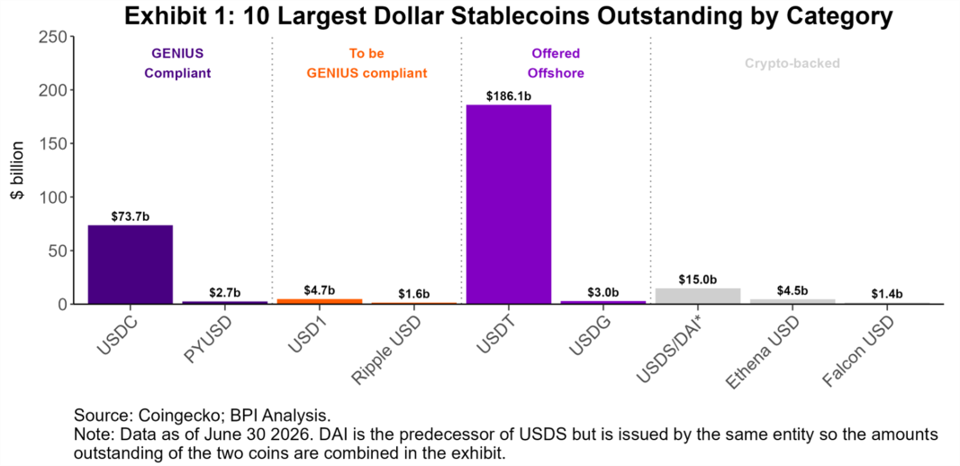
Only USDC and PYUSD had reserve assets that met the GENIUS Act’s requirements in a review of the ten largest dollar stablecoins by circulation, according to a Bank Policy Institute (BPI) research note by Laurence Bristow and Eva Funaki. Together, the two represented 26% of dollar-stablecoin circulation. Two more U.S.-issued tokens, USD1 and Ripple USD, did not yet meet the asset requirements but were categorized as expected to do so. The remaining 72% was split between offshore-issued tokens (65%) and crypto-backed tokens (7%).
BPI represents the U.S. banking industry. An editor’s note accompanying the original article cautioned that the research note’s conclusions are unfavorable to offshore and crypto-backed stablecoins; readers should bear that perspective in mind.
What the comparison measures
As reported on November 10, 2026, the GENIUS Act was due to take effect on January 18, 2027. Its reserve rules for payment stablecoins issued in the United States or offered to U.S. users require full backing with eligible liquid assets, including U.S. Treasury securities with no more than 93 days remaining to maturity, overnight reverse repurchase agreements backed by Treasuries, bank deposits and other qualifying assets. Meeting the reserve-asset test is not the same as a guarantee against a loss of the token’s peg.
BPI’s ten-token sample accounted for 97% of dollar-stablecoin circulation as of June 30, 2026. Its reserve data generally came from issuers’ monthly disclosures; USDT disclosed quarterly, while figures for Sky Protocol’s USDS and DAI came from on-chain data via Dune Analytics. The comparison concerns reserve composition, not a full audit of each issuer.
U.S.-issued tokens
Of the four U.S.-issued tokens in the sample, Circle’s USDC and Paxos’s PYUSD met BPI’s reserve-asset test as of June 2026. World Liberty’s USD1 and Ripple USD did not: BPI said their money market fund holdings included agency securities and longer-maturity Treasuries.
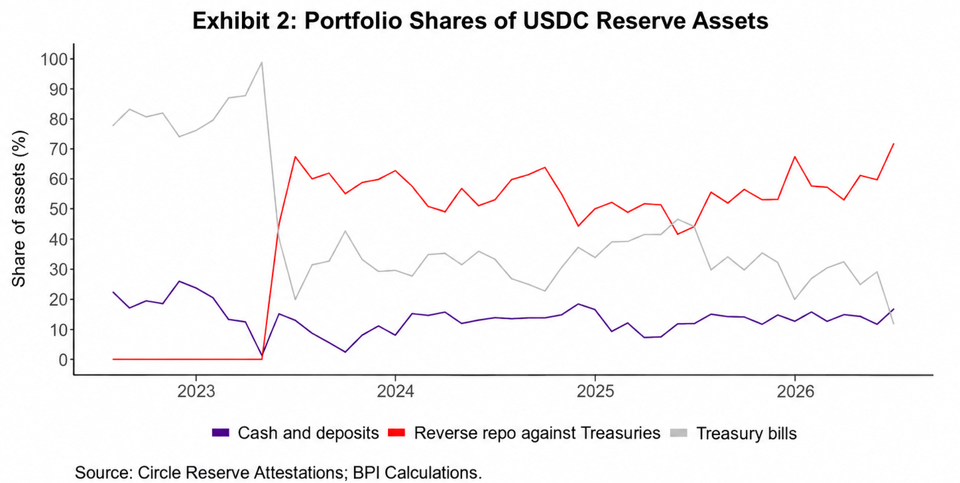
USDC had more than $73 billion in circulation. In July 2026, roughly 70% of its reserves were in Treasury-backed reverse repos; the remaining 30% was divided approximately equally between uninsured bank deposits and Treasury bills. The source traces a change in that mix to the 2023 Silicon Valley Bank crisis. It says USDC had previously held 85% of reserves in Treasury bills and 15% in uninsured bank deposits, with more than half of those deposits at Silicon Valley Bank. USDC’s market price fell as low as $0.87 during the episode. Circle subsequently reduced its Treasury-bill share and increased Treasury-backed reverse repos to improve liquidity.
Offshore-issued tokens
The source places USDT and Global Dollar (USDG) outside the Act’s direct scope because they are issued offshore. BPI also found that their reserve mixes did not meet its reading of the GENIUS asset requirements.
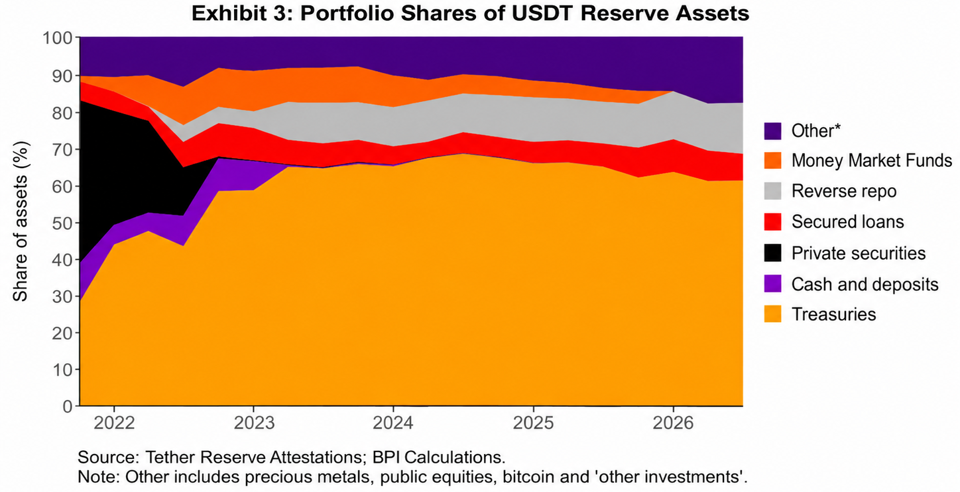
USDT, the largest token in the sample, had an operator based in El Salvador. As of June 30, 2026, Treasury bills made up 61% of its reserves and Treasury-backed overnight reverse repos 10%; bank deposits were a very small share. The other 29% included gold, publicly traded equities, bitcoin, secured loans, term repo loans and other investments. The source also recounts episodes in which USDT traded below its peg in October 2018, November 2022 and August 2023, while attributing the surrounding reserve, contagion and liquidity concerns to those periods.
USDG was issued by Paxos entities in Singapore and Europe. At June 30, 2026, its reserves comprised 53% government money market funds, 42% Treasury bills and 5% bank deposits. BPI’s objection to the fund holdings was that they could include Treasuries with maturities beyond 93 days and federal agency securities. The source reports that USDG also lost its peg briefly after launch in November 2024 amid insufficient trading liquidity.
The Act provides a possible route for foreign payment-stablecoin issuers to serve U.S. users, subject to a U.S. Treasury determination that their home-country regulatory system is comparable and a showing that the issuer can comply with U.S. legal orders. That route should not be confused with a finding that either token already qualifies.
Crypto-backed tokens
BPI does not expect crypto-backed tokens relying on crypto-collateralized loans to qualify as payment stablecoins under the Act’s reserve rules. Sky Protocol’s USDS and DAI together had nearly $14 billion in circulation, according to the source. USDS can be minted by exchanging USDC one-for-one, borrowing against crypto collateral through Sky’s DeFi lending protocol, or through affiliated entities receiving USDS credit lines for strategies including crypto-backed loans and tokenized real-world assets.
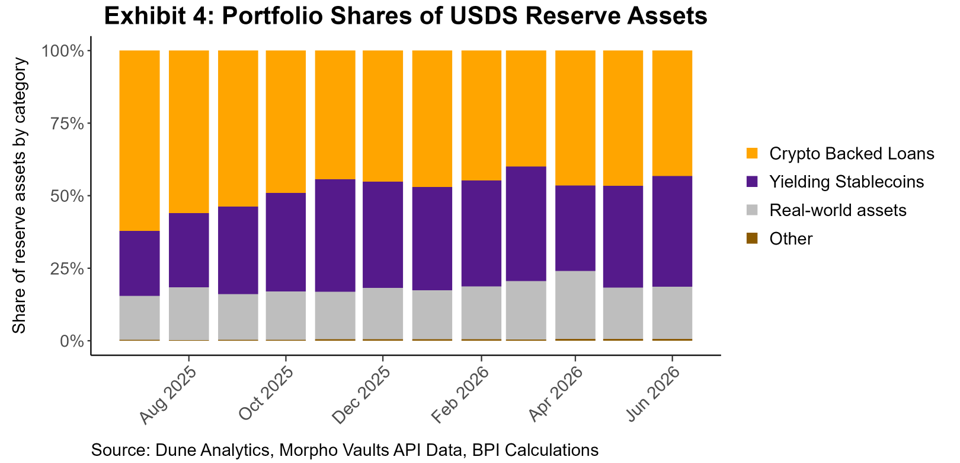
As of June 2026, USDS reserves were 42% crypto-backed loans, 38% stablecoins and 20% tokenized real-world assets. Nearly 90% of that real-world-asset portion consisted of tokenized funds investing in short-term Treasuries, reverse repos and AAA-rated collateralized loan obligations.
The source puts Ethena Labs’ USDe at approximately $4 billion in June 2026. It says USDe shifted away from its initial basis-trade strategy after returns declined and a severe depeg in October 2025; its backing then included tokenized real-world assets, yield-bearing stablecoins and crypto-backed loans on DeFi protocols.
The distinction: BPI’s finding is about whether disclosed reserve assets matched a forthcoming U.S. legal standard at the time examined. Offshore issuance and crypto-backed designs raise separate questions about which rules apply. Neither a matching reserve mix nor a failure to match it, on its own, determines whether a token’s market price will always hold at $1.
Original article, published November 10, 2026, 15:03:16 UTC+08:00.