Pump.fun announced on November 27, 2026, that it would charge an extra fee on trades in the Solana block where a new token is created, starting December 4. Only the wallet used to issue the token would be exempt. That distinction matters: a creator could still buy through the issuing wallet without paying the surcharge, but purchases bundled through other wallets in the same block would incur it.
Pump.fun said it would use half the proceeds for programmatic PUMP buybacks and burns. The other half would support its launch platform, app and trading terminal, including trading rewards and competitions. As of November 28, the platform had not disclosed the rate. It said the initial fee would be low and that it would publish the rate before the change took effect.
Why the creation block matters
Pump.fun launches meme tokens on a bonding curve: the price rises as more funds flow into purchases. Buying in the creation block, known as Block 0, can therefore give a trader access to a lower price. A purchase through the issuing wallet makes the creator’s stake visible. Bundling purchases across apparently unrelated wallets can conceal the size of that stake and make demand look broader than it is. A purchase by a wallet other than the issuer’s, however, does not by itself establish who controls it.
Bitquery found that 38% of roughly 8.2 million Pump.fun token launches it tracked from October 30, 2025, through October 7, 2026, had a Block 0 purchase by a wallet other than the issuer’s. By the end of June 2026, Bitquery estimated that creators and their bundled wallets had earned at least $579 million in cumulative profits, more than 18 times the $31.5 million it attributed to independent sniping bots.
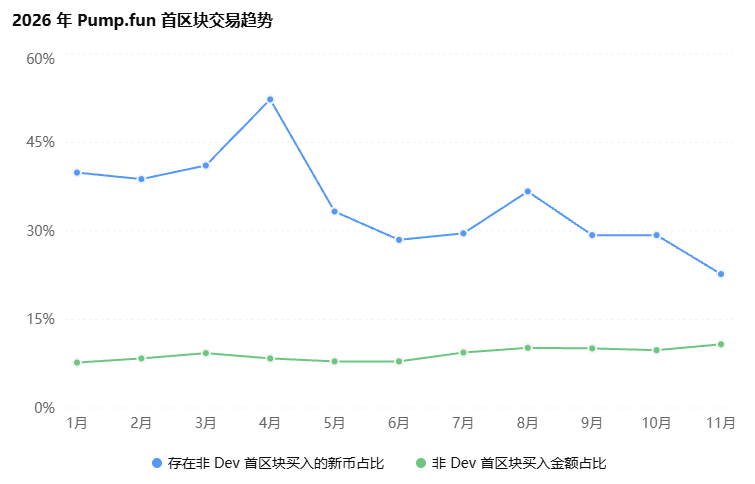
Data from pumpdata.fun show why the number of launches and the amount spent tell different stories. The share of launches with a first-block purchase outside the issuing wallet fell from 52.3% in April 2026 to 22.7% in November. Yet those purchases accounted for 10.8% of all bonding-curve buy volume in November, up from 7.7% at the start of the year. In November to date, such wallets had spent 1,183,500 SOL in Block 0. Just 973 wallets, each of which bought in the creation block of at least 100 tokens, accounted for 41.4% of that amount.
What happens in the next two blocks?
The announced fee applies to Block 0, not to the first or second block after creation. Those later blocks already attract buyers: over the same November period, pumpdata.fun counted about 96,500 launches with no Block 0 purchase outside the issuing wallet but with such purchases in Block 1 or Block 2. Those trades totaled 129,800 SOL. The figures predate the fee and do not show how traders will respond to it.
Pump.fun co-founder Alon did not rule out fees on later blocks, but the platform had not announced an extension. A broader fee could also fall on ordinary buyers as more traders enter and creator-linked wallets become harder to distinguish. The team said it did not expect a marked change on day one and would use trading data and community feedback to adjust the rate and scope after observing how creators, bots and trading tools respond.
The surcharge would add a revenue stream to a platform that on-chain analyst 0xMadaba estimated was already generating $636 million in annualized revenue, second only to Hyperliquid among the projects the analyst tracked. November’s first-block purchases outside issuing wallets averaged about 51,500 SOL per day. That is a pre-fee measure of buy volume, not a forecast of fee receipts or PUMP buybacks: both will depend on the rate and how much trading stays in Block 0.