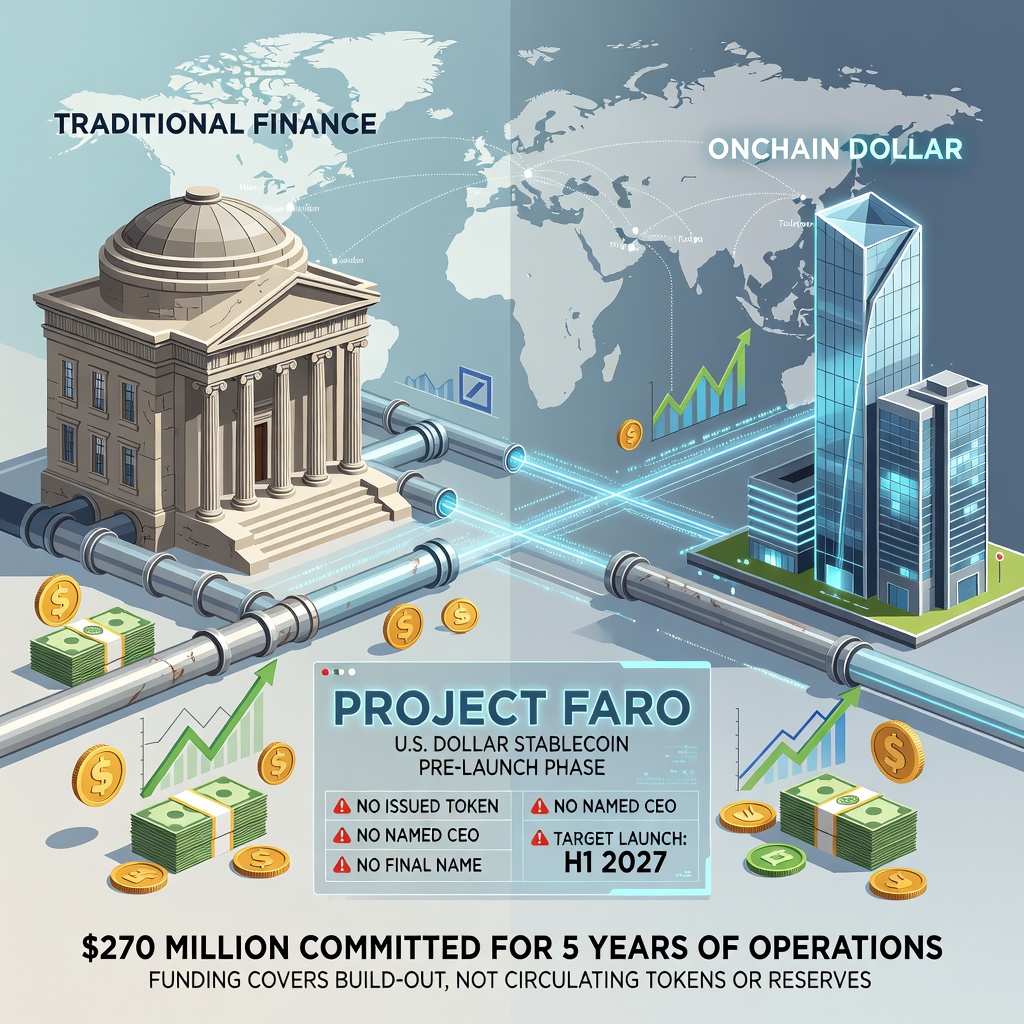
A planned U.S. company meant to issue a dollar-denominated stablecoin has operational funding, not a token in circulation. In a Decrypt article published November 11, 2026, the outlet reported that a group of global banks had committed around $270 million to cover five years of operations as the project moves from plan to buildout. Bloomberg reported the commitment the preceding Tuesday, citing people familiar with the matter. Goldman Sachs, Citigroup, Banco Santander, and Deutsche Bank are among the institutions backing the effort.
Participants know the venture as Project Faro. It is still searching for a chief executive, and its final name remains under discussion. A spokesperson for the project declined to comment. Santander and Deutsche Bank also declined to comment. Goldman and Citi referred questions to the project.
The capital funds the company that is intended to issue the stablecoin. It is not described as reserve assets posted against tokens, and no tokens have been issued. Decrypt framed the commitment as the next concrete step after an initiative that first went public late last year. As Decrypt had previously reported, 21 of the world’s largest financial institutions committed in September to form a company to issue a U.S. dollar stablecoin, targeting a launch in the first half of 2027, with a euro version and other currencies to follow. That consortium had more than doubled from an initial group of 10 banks that began exploring the idea in October 2025. It spans North America, Europe, East Asia, the Middle East, and Africa.
Beyond the four institutions named by Bloomberg, Decrypt listed participants that include Bank of America, Wells Fargo, Fidelity Investments, PNC, Capital One, TD Bank, UBS, BBVA, Deutsche Bank, Lloyds Banking Group, and MUFG, among others. JPMorgan is not on the list.
The project is one of several collaborative efforts by established finance in a business long dominated by crypto-native issuers. Visa, Mastercard, and Stripe are among more than 100 companies backing the issuer Open Standard. European banks have formed Qivalis to issue a euro-denominated coin.
Decrypt reported that, at the time of its article, Tether’s USDT and Circle’s USDC together accounted for about 85% of a market worth roughly $290 billion, nearly all of it dollar-pegged. The article did not give separate shares for USDT and USDC. When the bank consortium first went public in September, Circle’s stock fell about 6% as investors priced in the prospect of bank-backed competition for USDC.
The banks are betting that institutional trust, regulatory alignment, and existing client networks can win a share of settlement activity that promises round-the-clock, cross-border payments at lower cost than traditional rails. Those are stated commercial aims, not evidence that cheaper settlement is already available through this project.
The token is being designed to comply with the U.S. GENIUS Act, which created the first federal framework for dollar-pegged tokens in 2025, and, where applicable, the EU’s MiCA regime. The group has said it wants the stablecoin used across wholesale, institutional, and retail markets. Design goals and a stated compliance target are not the same as an issued token, posted reserves, an attestation, or an audit. The source does not describe reserves, redemption terms, or any third-party review, which is consistent with the project still being pre-launch.
Project Faro has no issued token, no named CEO, and no final name. Its first-half-2027 target leaves room for delay. The roughly $270 million commitment is a signal that the consortium intends to fund a bid for the onchain dollar rather than leave that business only to crypto-native issuers. It does not show a circulating stablecoin, guaranteed redemption, or insured deposits.
Original article: Goldman, Citi and Global Banks Commit $270 Million to Challenge Crypto’s Stablecoin Giants, Decrypt, November 11, 2026.