
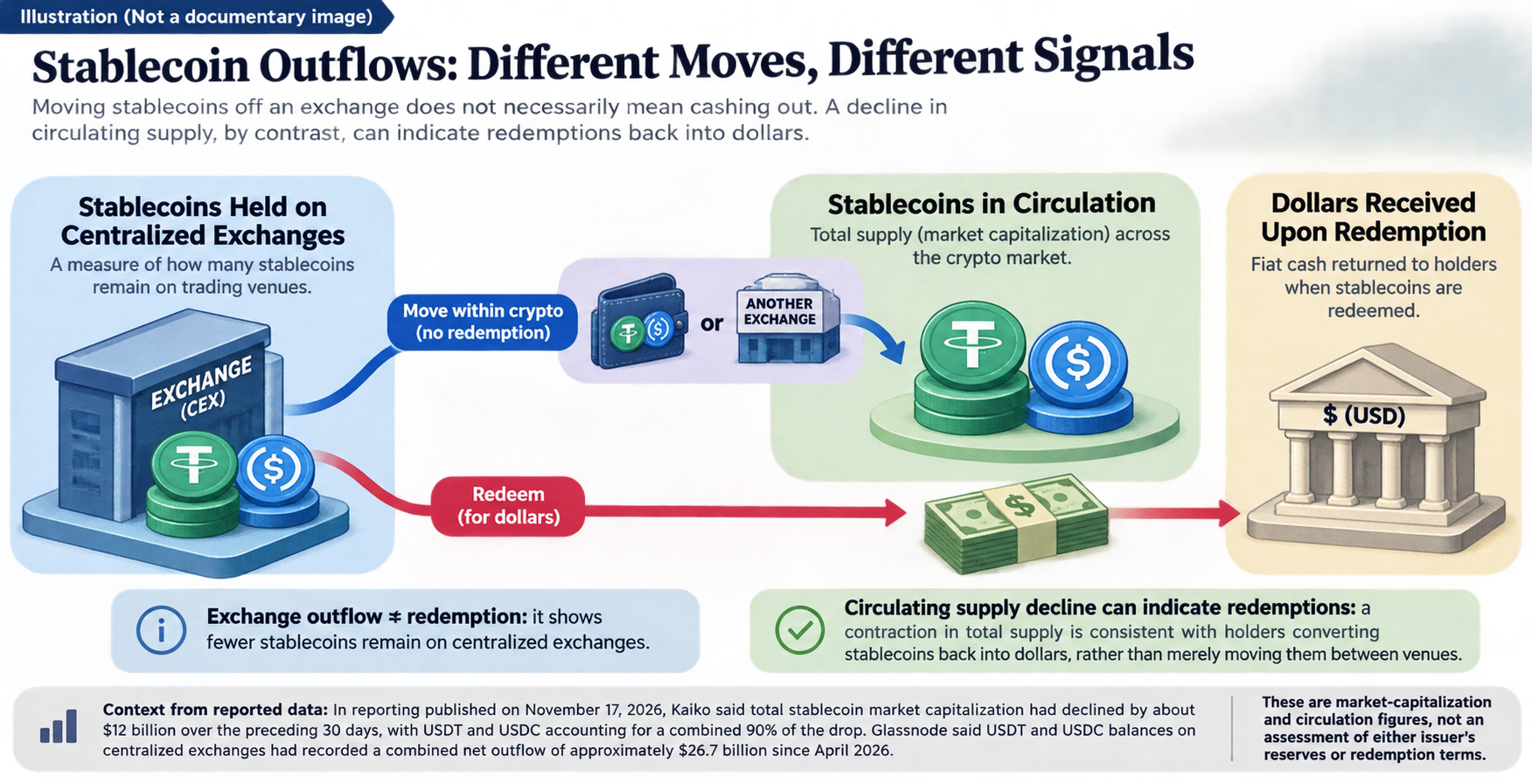
Stablecoins can leave an exchange without leaving the crypto market: a holder might move tokens to another wallet or trading venue. A decline in circulating supply is a different signal. In reporting published on November 17, 2026, Kaiko described a contraction in both USDT and USDC and interpreted it as evidence that holders were converting stablecoins back into dollars rather than rotating between tokens.
Kaiko’s data put the decline in total stablecoin market capitalization at about $12 billion over the preceding 30 days—the fastest contraction since the 2022 Terra-Luna collapse, according to the report. USDT, issued by Tether, and USDC, issued by Circle Internet Group, accounted for a combined 90% of that decline. Kaiko research head Anastasia Melachrinos said each had shrunk by about 4%, with neither losing its dollar peg during the period. She interpreted their parallel declines as a sign of broader cash withdrawals, rather than a flight from one issuer to the other.
The exchange-balance figures measure something narrower. Glassnode researcher Sean Rose said USDT and USDC balances on centralized exchanges had recorded a combined net outflow of approximately $26.7 billion since April 2026. An exchange outflow does not, by itself, establish that the tokens were redeemed for dollars; it shows that fewer of them remained at those trading venues.
Glassnode put total stablecoin market capitalization at a record $312.6 billion on April 17, 2026, compared with about $284 billion at the time of the report. Rose contrasted the simultaneous USDT and USDC contraction with the 2022–2023 downturn, when he said the market shrank by roughly 35% while USDT continued to expand.
These are market-capitalization and circulation figures, not an assessment of either issuer’s reserves or redemption terms.