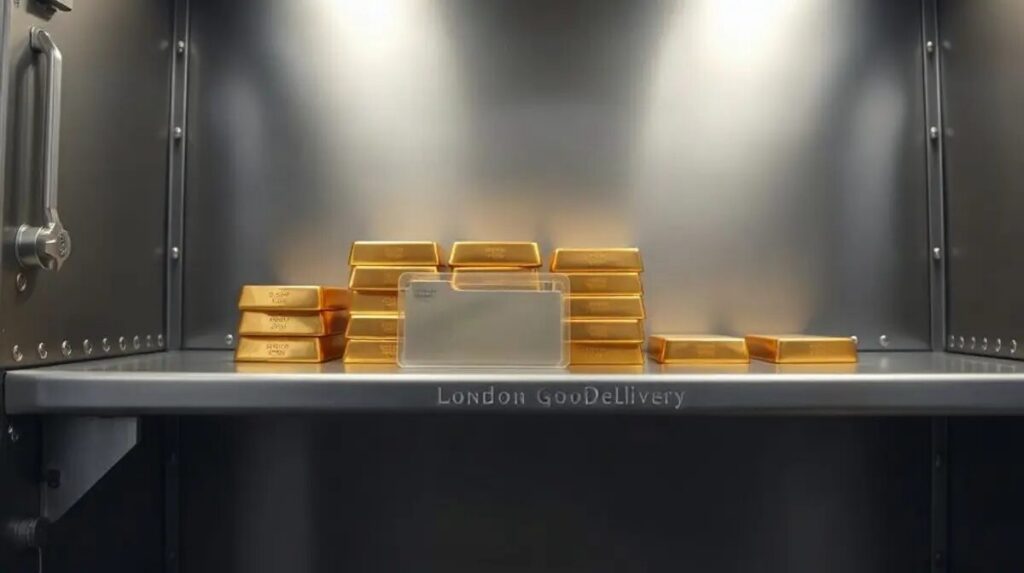
Paxos will deliver one physical London Good Delivery gold bar only if a holder submits at least 430 PAXG, holds a verified Paxos account, and arranges delivery. Each token represents one fine troy ounce of allocated gold, so the bar route is a whole-bar minimum, not a claim on a miniature bar. Crypto.news reported the threshold on November 23, 2026. At an illustrative $3,500 an ounce, 430 tokens are worth about $1.505 million before charges. That dollar figure is a scenario, not a live quote.
The token count does not move with the gold price. The same 430-token requirement is worth about $1.290 million at $3,000 an ounce, $1.720 million at $4,000, and $1.935 million at $4,500, in each case before fees or delivery costs. A balance below 430 tokens cannot use the physical-bar exit. Those holders sell on a supported market or convert to cash.
Three exits, not one vault withdrawal
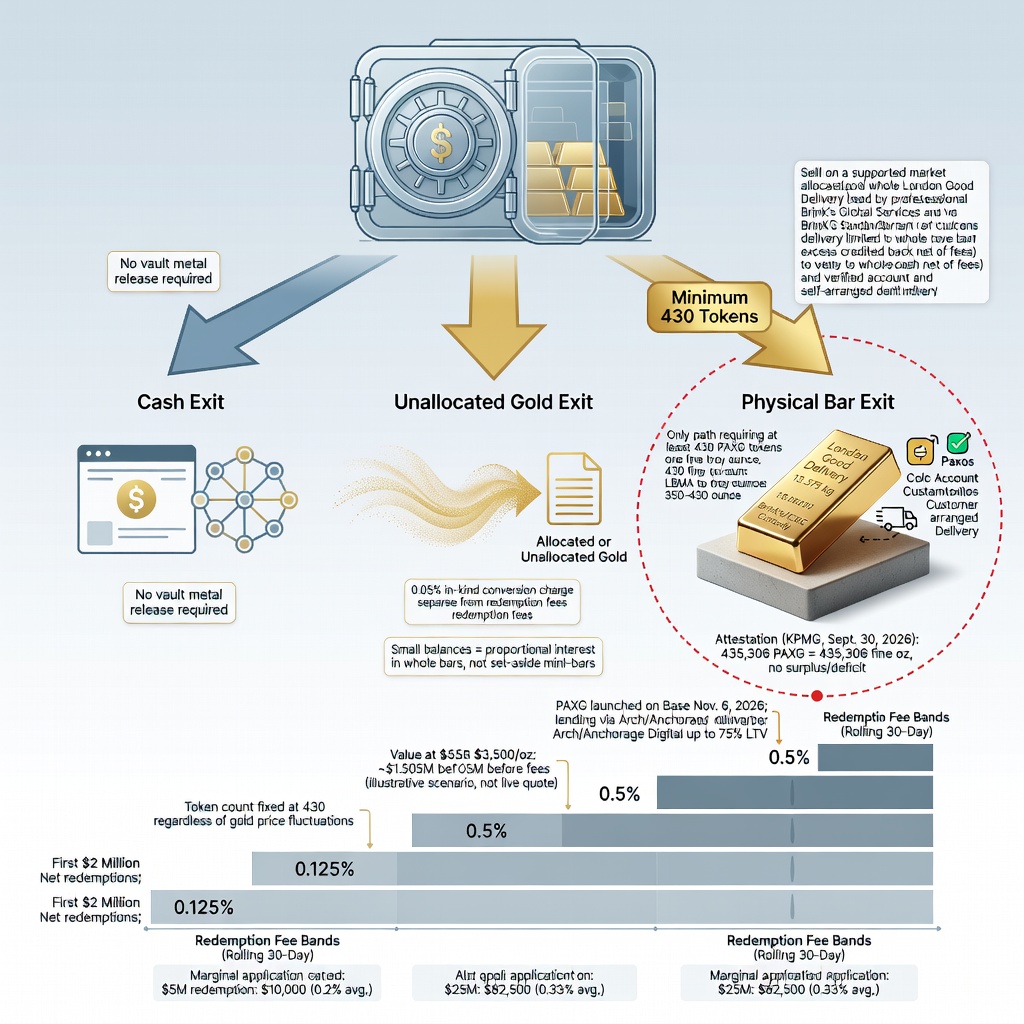
Paxos’s documents set out three separate exits: cash, unallocated gold, or a physical bar. Each ends in a different asset, with its own counterparty, schedule, and cost. Selling PAXG to another market participant does not require the vault to release metal.
Paxos describes PAXG as beneficial ownership of allocated gold held on a segregated basis, in whole bars in professional custody. A small balance is a proportional interest in those bars. One token is roughly 0.23% of the 430-token submission requirement, and ten tokens are about 2.33%, according to Crypto.news. Those positions still correspond to the stated ounces. They do not reduce the delivery minimum.
What 430 tokens buys, and what is credited back
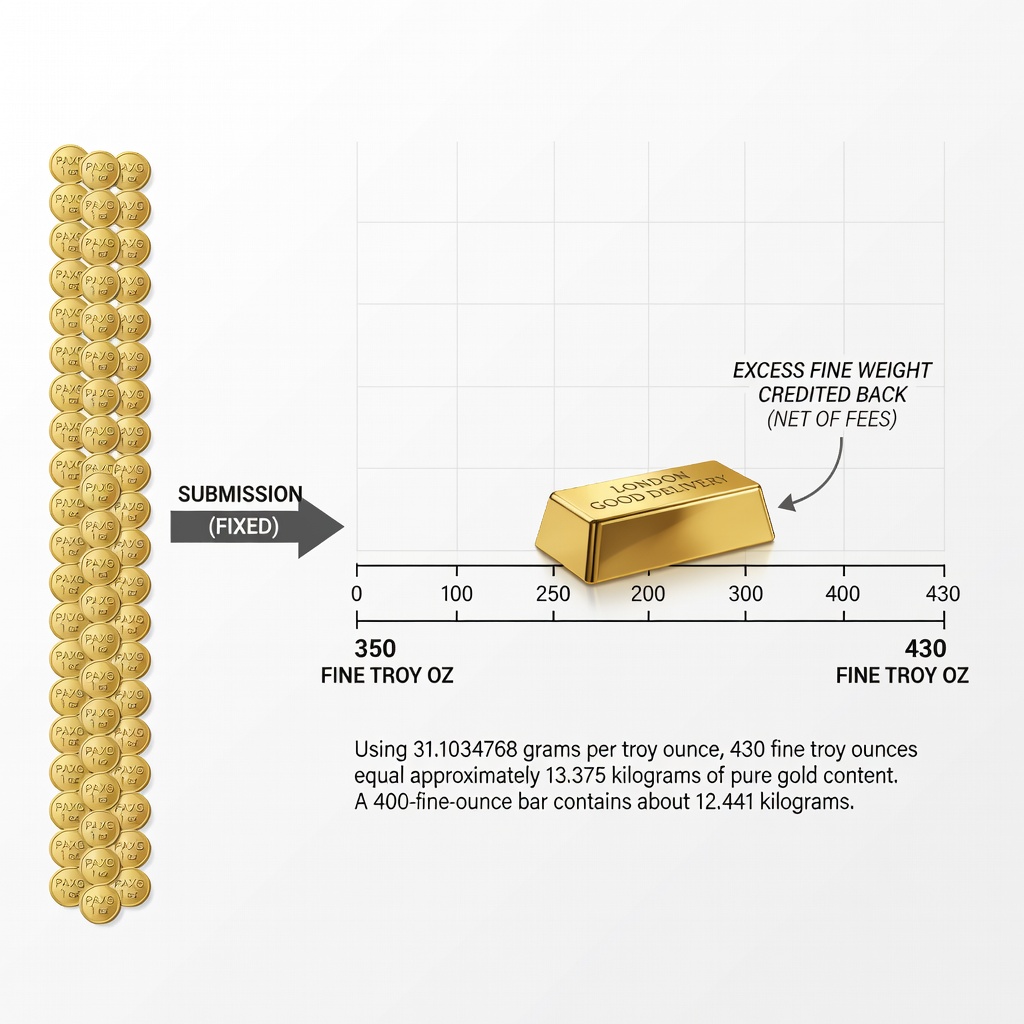
LBMA Good Delivery specifications allow gold content of 350 to 430 fine troy ounces per bar. Tokens submitted above the selected bar’s actual fine weight are credited back, net of fees.
Using 31.1034768 grams per troy ounce, 430 fine troy ounces equal about 13.375 kilograms of pure gold content. A 400-fine-ounce bar contains about 12.441 kilograms. A holder who submits 430 tokens for a smaller eligible bar would have the difference credited back before applicable fees.
Market price, redemption fees, and who sets the hours
Paxos’s PAXG overview says direct pricing uses StoneX’s London gold market quotations. Purchases and sales run during London market hours from Sunday evening to Friday afternoon, US Eastern time, including a daily closure and applicable holidays. An exchange order book can stay open outside those hours at whatever price bids, offers, and liquidity allow. An exchange price is not the same thing as Paxos’s redemption terms.
In-kind conversion into allocated or unallocated gold carries a 0.05% charge. That charge is separate from the rolling 30-day redemption fee schedule revised from September 1, 2026. The redemption bands start at 0.125% on the first $2 million of net redemptions and rise to 0.5% above $20 million inside a rolling 30-day window. The bands apply marginally. Activity in the prior 30 days can push part of a new request into a higher tier.
On the illustrative $1.505 million position, an account still in the first band would pay 0.125%, or $1,881.25. A further 0.05% in-kind charge on the same value is $752.50. Combined, that is $2,633.75 before delivery. From a zero starting point, a $5 million redemption costs $10,000, a 0.2% average. A $25 million redemption costs $82,500, or 0.33% on average.
A matched attestation is not a reserved bar
Paxos offers a bar lookup tool. Its support page notes that exchange wallet structures can prevent the tool from identifying an individual customer’s allocation. The company’s engineering account, as cited by Paxos senior software engineer Jayden Thompson, describes an event-driven system that can move a holder’s interest between bars while total ounces stay unchanged. A specific serial number is not a permanent reservation for delivery.
The latest linked monthly attestation covers September 30, 2026, and was issued by KPMG with an opinion dated October 23, 2026. It reports 435,306 redeemable PAXG against 435,306 fine troy ounces of gold at 5 p.m. Eastern, with no surplus or deficit on that date. That is an attestation with an opinion, not a full audit, and it speaks to that cutoff rather than to a later balance. Ethereum accounts for 432,506 of those tokens, about 99.36%, with the rest on other native issuances. The asset exhibit names Brink’s Global Services and ICBC Standard Bank as storage providers.
Borrowing sits in front of the same bar rule
PAXG launched natively on Base on November 6, 2026. The deployment was presented as a way to keep gold exposure while borrowing against it. Lending integrations were described as dependent on product availability.
Arch accepts PAXG and XAUT as collateral through Anchorage Digital custody, with a disclosed starting loan-to-value of up to 75%. At $100,000 of collateral and a 75% starting loan, debt is $75,000 before interest. A 10% decline in collateral value leaves $90,000 against that debt, a ratio of roughly 83.3%. Starting LTV is not automatically the liquidation threshold. Each product’s contract supplies its own terms.
PAXGy, a gold-leasing token, adds another conversion. It redeems into PAXG at an exchange rate affected by its reserve strategy, and only then do Paxos’s eligibility and bar-size rules apply. Paxos’s terms also reserve freeze and upgrade powers over the token, so control of the keys does not remove the issuer from the asset.
Exposure and metal are different tests
For price exposure, the token can stand in for bullion without a vault withdrawal. For a plan that depends on holding metal, the test is the exit, not the wallet balance. Near an illustrative $3,500 an ounce, direct delivery of one bar is a seven-figure position. Most retail holders are in practice choosing among an exchange sale, a cash conversion, and any partner-retailer route: three counterparties and three sets of charges.
The 430-token minimum does not contradict the stated one-ounce backing of each token. It limits physical delivery of a whole London Good Delivery bar. The terms do not make PAXG guaranteed, insured, or redeemable for metal at any size.
The next monthly reserve attestation is the point that will show whether the token count and reported fine ounces still match one-to-one after the Base launch. Holders weighing a direct exit would also be watching for any revision to the redemption fee bands or to the partner-retailer fractional route described in January.
Gold-linked token prices are volatile. Price-based figures in this article are illustrative scenarios, not live quotations, and this is not financial, investment, legal, or tax advice.