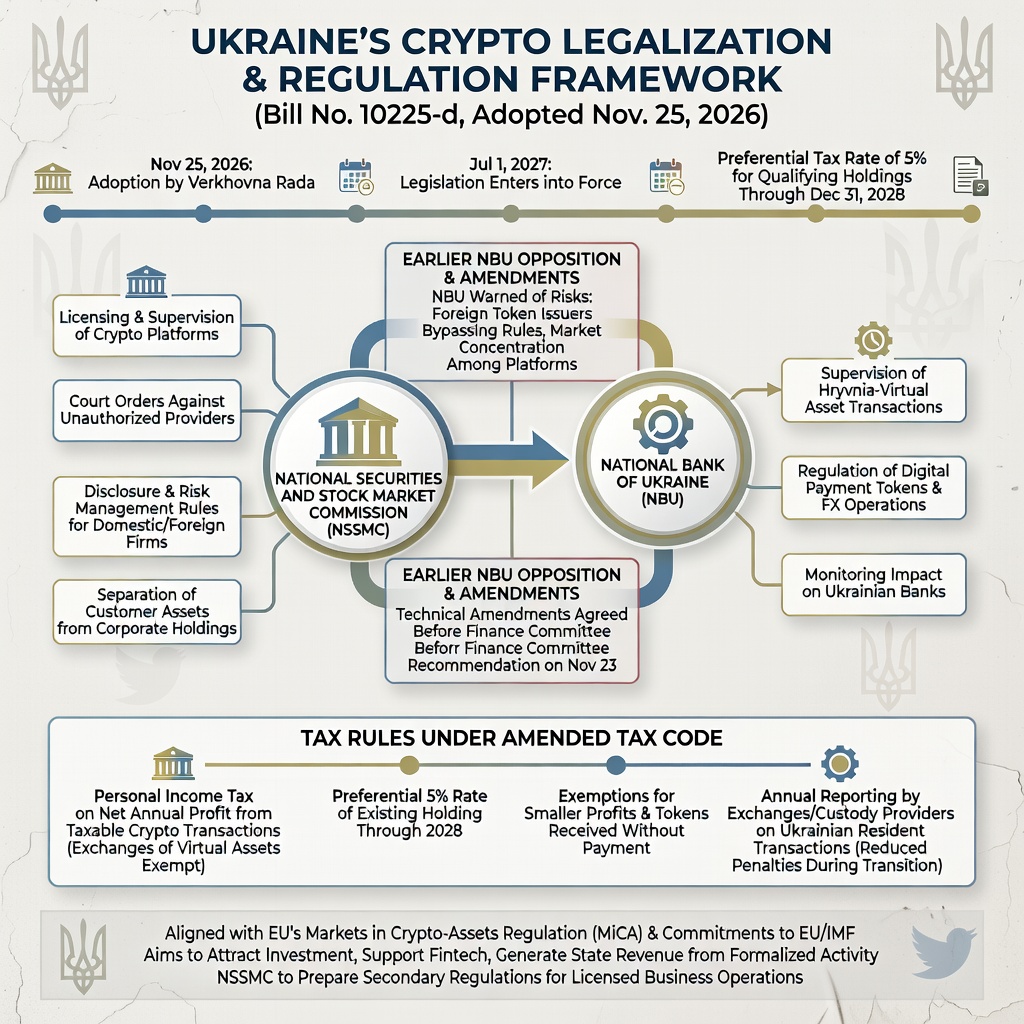
Ukraine’s parliament voted on November 25, 2026, to legalize and regulate the country’s cryptocurrency market. The Verkhovna Rada said 271 lawmakers voted to adopt Bill No. 10225-d in its second reading and in full. The rules are not yet in effect: the National Securities and Stock Market Commission (NSSMC) said the legislation is scheduled to enter into force on July 1, 2027.
Who will oversee trading, custody and payment tokens?
Under the division of responsibilities outlined on November 23, the NSSMC will license crypto platforms and supervise their operations. It will also be able to seek court orders against providers operating without authorization. Domestic and foreign firms offering trading, exchange or custody services in Ukraine will face disclosure, risk management and market manipulation rules. Firms holding crypto for customers will have to keep those assets separate from their own.
The National Bank of Ukraine (NBU) will supervise transactions involving the hryvnia and virtual assets, regulate certain digital payment tokens and foreign exchange operations, and monitor how crypto activity affects Ukrainian banks.
Earlier in November, the NBU opposed the bill, warning that some provisions could let foreign token issuers bypass domestic rules and could concentrate too much business among a small number of trading platforms. The regulators agreed on technical amendments before parliament’s finance committee renewed its recommendation for adoption on November 23.
How would the tax rules apply?
The legislation amends Ukraine’s Tax Code and gives individuals a way to legalize holdings acquired before the framework takes effect. The revised draft, as reported on November 24 when lawmakers postponed its review, based personal income tax on an individual’s net annual profit from taxable crypto transactions. Exchanges of one virtual asset for another would be exempt.
The draft included a preferential personal income tax rate of 5% through the end of 2028 for qualifying existing holdings, along with exemptions for certain smaller profits and tokens received without payment. Exchanges and custody providers would report transactions involving Ukrainian residents annually, with reduced penalties during a transition period.
The bill received 246 votes at its first reading in September 2025. The NSSMC said lawmakers drew on the European Union’s Markets in Crypto-Assets Regulation and that the legislation forms part of Ukraine’s commitments to the EU and the International Monetary Fund. The commission said it will prepare the secondary regulations that set out how licensed businesses must operate.