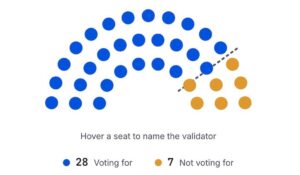
Bitcoin deposited in a proposed US reserve 15 years after enactment would have to stay for about five years, not another 20. Under the version of the American Reserve Modernization Act (H.R. 8957) reported to the House on November 24, 2026, the minimum holding period would end on the same date for every deposit. Reaching that date would not, by itself, authorize a sale.
The bill was placed on the Union Calendar two months after the House Financial Services Committee approved it 28–21. Before that vote, the committee adopted substitute text from Rep. Bryan Steil (R-Wis.) by voice vote and rejected an amendment from Rep. Maxine Waters (D-Calif.) by a vote of 21–28. The bill still needs a House floor vote, Senate passage of identical text and the president’s signature to become law.
How long would Treasury have to hold each deposit?
When Rep. Nick Begich (R-Alaska) introduced the bill on May 21, 2026, with 22 cosponsors, it set two minimum holding periods. For bitcoin the government already held, the 20 years would run from enactment. For subsequent acquisitions, the period would run from deposit. The Steil substitute retains only the enactment date.
Treasury would have 180 days after enactment to establish the reserve, and agencies would have another 30 days to transfer their holdings. Time spent setting up the reserve would therefore count toward the minimum. A deposit in year 10 would have about 10 years left to run. A deposit after year 20 would face no minimum holding period, though the rules governing sales would still apply.

Which bitcoin would enter the reserve?
Seizure alone would not qualify bitcoin for transfer. The federal government would have to own the coins, and no law could require their use for another purpose. Bitcoin finally forfeited in criminal or civil proceedings, or applied to a civil money penalty, could qualify. Bitcoin needed to meet obligations of the Treasury Forfeiture Fund under 31 U.S.C. 9705 would be excluded. Treasury would take legal title to eligible coins upon transfer.
A North Carolina case illustrates why even final forfeiture need not make coins available. In August 2021, callers posing as federal investigators persuaded an elderly Asheville man to use retirement savings to buy 12.164699 BTC, then worth about $574,766, and send it to an account they controlled. Coinbase and the FBI flagged the transfer. The United States obtained the coins through civil forfeiture, but in March 2022 federal prosecutors announced that the bitcoin would be returned to the victim.
Pending establishment of the reserve, agencies would transfer qualifying holdings to Treasury where practicable and could not sell or pledge them. Section 7 preserves court-ordered dispositions, returns to identifiable victims, national security uses and other dispositions required by law. Existing federal forfeiture statutes would continue to apply.

What would it take to sell?
During the holding period, Section 5 would prohibit Treasury from selling, swapping, auctioning, encumbering or otherwise disposing of reserve bitcoin for any purpose. Within a year of enactment, Treasury would have to recommend to Congress conditions that might justify an early sale, including on national security or financial stability grounds. Those recommendations would not create exceptions; Congress would have to enact them.
Two years before the period ends, Treasury would advise Congress whether to continue holding or allow a gradual release. It would consider the federal deficit, bitcoin’s long-term viability as a strategic investment and the market effects of sales. After the minimum expires, Treasury could recommend selling up to 10% of the reserve in any two-year period. An actual sale would require a Treasury rule explaining the process, how the schedule was chosen and how market disruption would be limited. Proceeds would cover reserve management costs first, with the balance going toward the national debt.
What would the public be able to verify?
The March 6, 2025, executive order directed that reserve bitcoin not be sold. It gave agencies 30 days to account for their digital assets to Treasury and the President’s Working Group on Digital Asset Markets, without requiring public disclosure. It also directed Treasury and Commerce to develop budget-neutral acquisition strategies. The bill would put a 180-day study of those strategies into statute without authorizing borrowing, collateral pledges, new taxes or deficit spending to buy bitcoin.
The May bill called for quarterly public reports. The House-reported version would instead require one independently verified public report a year covering reserve holdings, transactions and private-key control. Separately, Treasury would have to build a public cryptographic attestation system so outsiders could check reported holdings against keys Treasury controls. The Comptroller General would have an ongoing oversight role. Treasury would also report to the House Financial Services and Senate Banking committees within 360 days of establishing the reserve and annually thereafter.
The public reserve figure would not be an inventory of all federal digital assets. Within 60 days of enactment and annually thereafter, each agency would have to tell Treasury what bitcoin and other digital assets it holds, has seized or otherwise controls. The bill would not require publication of those broader totals, which could include coins still in litigation or awaiting return to victims.