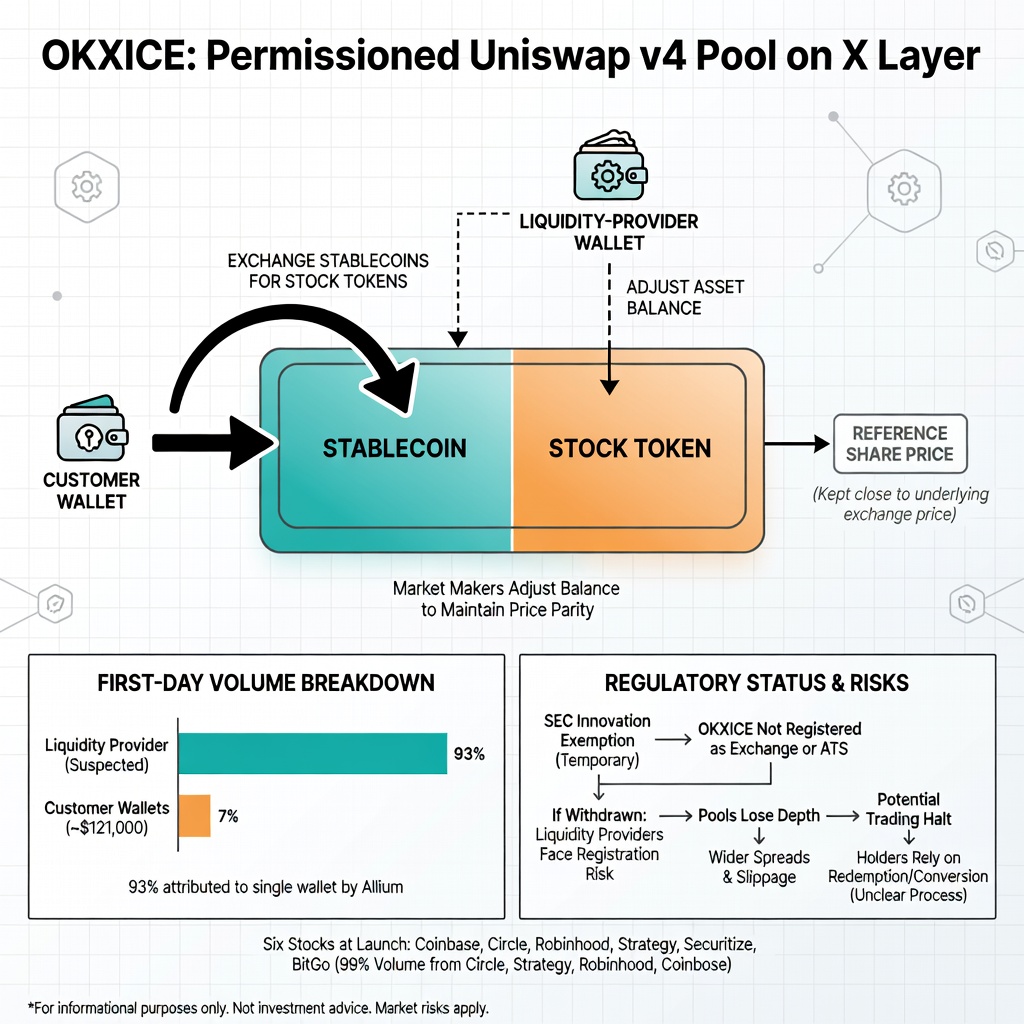
OKXICE opened trading in six tokenized U.S. stocks through onchain pools that pair stock tokens with stablecoins. By the U.S. market close on its first day, the platform had recorded about $1.64 million in trades. Onchain analytics firm Allium attributed 93% of that volume to a single wallet it identified as a likely liquidity provider. Customer wallets accounted for about 7%, or roughly $121,000.
The distinction matters for the venture between OKX and Intercontinental Exchange, the parent of the New York Stock Exchange. Its pools handled trades, but the headline volume says little about how many customers want to trade shares this way. A separate question is how long the venue can operate under its current terms: U.S. senators have asked the Securities and Exchange Commission to withdraw the exemption it relies on. As of November 28, 2026, the SEC had not done so.
What the first day measured
Rather than matching buy and sell orders on an exchange order book, OKXICE uses permissioned Uniswap v4 liquidity pools on X Layer. A customer can trade stablecoins for stock tokens directly against a pool. Market makers adjust the balance of the two assets to keep the token price close to the exchange price of the underlying share. Those trades count toward volume, too. A high share of activity from a suspected market maker is not, by itself, evidence of wash trading.
The six stocks available at launch were Coinbase, Circle, Robinhood, Strategy, Securitize and BitGo. Circle, Strategy, Robinhood and Coinbase together accounted for 99% of first-day volume. All six companies have ties to crypto assets or digital securities, making the debut a narrow test of demand in a broader market. Token Terminal put the market value of tokenized stocks at about $4.8 billion on November 13, 2026, after 9.1-fold growth over 12 months.
Why only six stocks made it to launch
OKXICE plans to introduce 113 assets in phases, including individual stocks, exchange-traded funds and exchange-traded products. But its five-year SEC innovation exemption gives listed companies a say. When an unaffiliated third party issues a stock token, the platform must give the underlying company advance written notice and 30 days to object. An objection prevents OKXICE from listing that company’s token.
By October 21, 16 companies had objected, including Microsoft, Google parent Alphabet, Goldman Sachs and McDonald’s. By launch, about 56 of the 62 companies initially selected had objected. The remaining six made up the opening lineup.
What the senators want withdrawn
After the launch, Democratic senators including Elizabeth Warren and Chris Van Hollen wrote to SEC Chair Paul Atkins seeking withdrawal of two distinct measures. One is the exemption already in effect for venues such as OKXICE. The other, Regulation Crypto Assets, is a proposal that would allow certain crypto projects to raise funds under exemptions from the Securities Act of 1933.
The senators argued that the SEC had allowed platforms to bypass national securities exchange registration and some traditional market rules without a full public comment process. In their view, that could create a “shadow stock market” with inadequate investor protections. Their letter did not change the law or halt trading.
OKXICE is neither a registered national securities exchange nor an alternative trading system. The exemption temporarily excludes it from the Exchange Act’s definition of an exchange and relieves certain pool liquidity providers of dealer registration. Without that relief or another regulatory basis, OKXICE could not continue in its present form. Operating as a regulated exchange or an alternative trading system would require changes to its brokerage, trade reporting and compliance arrangements.
Selling into a pool is not the same as redeeming a token
If the SEC withdrew the exemption, liquidity providers could face registration or enforcement risk if they kept making markets. A major provider’s withdrawal could leave less liquidity in the pools, widen spreads and increase slippage. Round-the-clock trading could stop.
The stock tokens are backed one-for-one by underlying shares. Ending the trading exemption would not make those shares disappear, but holders unable to sell into a pool might have to wait for the platform and token issuer to arrange redemption or conversion. Public documents do not clearly specify how soon redemption would be available, whether requests could be processed after hours or on weekends, how tokens would leave the pools, or which record would prevail if onchain balances differed from offchain custody records.
The stakes are specific to this route into the market. TSV LLC had already completed an institutional test on Canton Network under the innovation exemption. OKXICE was the first platform to offer U.S. retail customers broad, in-app access to round-the-clock tokenized U.S. stock trading under it. Nasdaq, the NYSE and the Depository Trust & Clearing Corporation could still pursue tokenized settlement within the existing securities system without this exchange exemption. What is at issue for OKXICE is whether customers can trade stock tokens directly against stablecoin pools—and whether enough customers and listed companies will choose to participate while that option remains open.